
She’s Thirteen and Still Not Sleeping in Her Own Bed
Why a teenager’s fear isn’t immaturity or manipulation, and why “she should have grown out of this” keeps everyone stuck
🟡 Busy Parent Snapshot
Your teenager still isn’t sleeping in her own bed. She’s thirteen, capable and bright in every other way, and yet night after night she ends up in your room, or needs you in hers. Part of you aches for her. Part of you is quietly frustrated, and worried about what it means. Shouldn’t she have grown out of this by now?
That very question, reasonable as it feels, is part of what keeps everyone stuck.
💡 What if your teen’s fear isn’t immaturity, attention-seeking, or a habit she won’t break, and instead a nervous system that still doesn’t feel safe?
🧠 What if age has nothing to do with it, because a survival state doesn’t check how old someone is?
✨ What if the pressure to “grow out of it” is quietly making it harder for her to let it go?
This is the story of one thirteen year old girl, and what finally helped her feel safe enough to sleep.
The Teenager Who Wasn’t Sleeping Alone
Let me tell you about a girl I’ll call Mia. She’s thirteen.
By day, Mia is who you’d hope a thirteen year old would be.
Funny, sharp, independent, doing well at school, rolling her eyes at her parents in all the usual ways.
From the outside, thriving.
At night, it is a different story.
Mia isn’t sleeping in her own bed.
She lies awake, anxious, until she ends up in her parents’ room, or one of them ends up in hers.
It has been this way, on and off, for years, and lately it has intensified.
Her parents are caught in something painful.
They love her, and they want to comfort her.
They are also exhausted, and quietly worried.
She is thirteen.
Her friends have sleepovers.
What happens at camp, or when she wants to stay at a friend’s house?
Shouldn’t this be behind her by now?
That word, “should,” had crept into everything.
It was making it worse.
Age Has Nothing to Do With It
Here is the thing that changes how you see this.
A survival state does not check how old someone is.
We expect fear to shrink as children grow.
A nervous system does not work on a timetable.
If a younger Mia’s system learned, at some point, that night-time or separation was not safe, that learning does not expire on a birthday.
It stays until the system receives clear, felt evidence that things are different now.
So Mia is not behind.
She is not immature.
She is not clinging on to a baby habit.
Her nervous system is doing at thirteen exactly what it would do at three or thirty.
It is protecting her from something it still perceives as a threat.
The behaviour looks out of place for her age.
The survival state underneath it is completely ordinary, and completely understandable.
💡 Takeaway #1
A survival state doesn’t check a child’s age.
Fear doesn’t shrink just because a child grows.
Mia isn’t immature or behind.
Her nervous system is protecting her from something it still perceives as unsafe, exactly as it would at any age.
Why “You Should Have Grown Out of This” Backfires
Mia believed, better than anyone, that she was “too old” for this.
She felt it every night.
The embarrassment.
The frustration with herself.
The sense that something must be wrong with her, because no one else her age seemed to struggle like this.
So when the message from the adults around her, spoken or unspoken, was “you’re thirteen, you should be over this,” it did not motivate her.
It landed exactly where her own harshest thoughts already lived.
It added shame to fear.
Shame is not neutral.
To a nervous system, shame is another threat.
It raises the very activation that drives the fear.
The pressure to grow out of it left her feeling less safe, not more, which made sleeping alone even harder.
This is the trap so many families fall into with teenagers.
We assume maturity should be there, so we treat fear as a choice.
Treating fear as a choice, at any age, only deepens it.
Where Did the Fear Begin?
Here is a question worth getting curious about.
When was the first time night-time, or being apart from a parent, may have felt genuinely unsafe to Mia?
A frightening night when she was small.
A period of illness or upheaval.
A time when the dark, or being alone, or separation, carried real fear that her young system could not settle.
Because somewhere back there, a fear-state was created.
Not simply a fear of the dark, and a fear of that helpless, unsafe feeling ever returning.
Her system decided that being near a parent at night was how it stayed safe, and it held on to that solution long after the original moment passed.
This invitation is gentle, and it is important to hold it lightly.
You are not hunting for a single event, or looking to blame anyone, and you may never know the exact moment.
Mia’s system does not respond to a date on a calendar.
It responds to a felt sense.
The reason curiosity matters is what it does for you. It quietly shifts the question from “why won’t she just grow up” to “what is she still protecting herself from.”
That shift changes everything about how you show up at bedtime.
💡 Takeaway #2
Pressure to “grow out of it” adds shame to fear.
To a nervous system, shame is another threat, which raises the very activation driving the fear.
Your teen is not choosing this.
Curiosity about where the fear began softens your response far more than any reminder of how old they are.
What Actually Helped
Mia’s parents made a difficult, counter-intuitive shift.
They took the pressure off.
They stopped framing bedtime as a problem Mia needed to fix, and started treating it as a nervous system that needed to feel safe.
The goal was no longer “get her sleeping alone by force.”
It was “help her system feel safe enough that sleeping alone becomes possible.”
They dropped the “you’re too old for this” entirely.
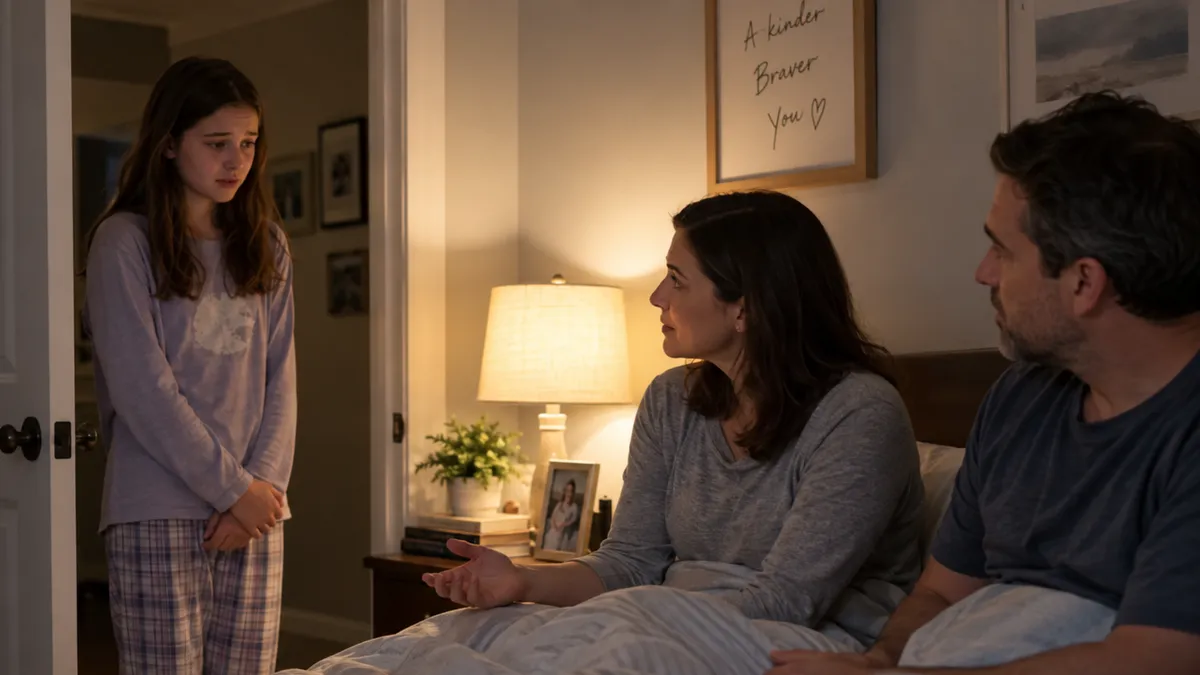
Instead, one evening, her mum sat on the edge of Mia’s bed and said something Mia had never heard before.
“I don’t think there’s anything wrong with you. I think a part of you learned that night-time isn’t safe, a long time ago, and it’s been working really hard to protect you ever since. That makes complete sense to me. We’re going to help you feel safe, together, with no rush and no pressure.”
Something loosened in Mia that night.
For the first time, she was not a thirteen year old failing to be normal.
She was a girl whose system had been protecting her, finally understood.
From there, the work was gentle and gradual.
Presence instead of pressure.
Her parents stayed close at first, then slowly, at Mia’s pace, less so, always with her nervous system leading rather than the calendar.
They helped her body learn, through real experience, that night could be safe now.
As the shame lifted and the safety grew, Mia’s system had less to protect.
Bit by bit, sleeping in her own bed stopped feeling like a threat and started feeling possible.
Not because she was forced.
Because she finally felt safe.
💡 Takeaway #3
A teenager’s fear is uncreated the same way a young child’s is.
Through safety, presence, and no pressure, at the nervous system’s pace rather than the calendar’s.
When a teen feels understood instead of judged, the shame lifts.
When the shame lifts, the system finally has room to let the fear go.
💡 What You Can Practise This Fortnight
Drop the word “should.” Catch “she should have grown out of this” and set it down. Your teen already believes it, and it only adds shame to fear. Age is not the measure. Safety is.
Name it as protection, not immaturity. Say out loud, “there’s nothing wrong with you. In a past moment in time you learned this wasn’t safe, and your body has been protecting you ever since.” Understanding what’s really happening and being understood is what lets a teen’s guard come down.
Get curious about where it began. Gently wonder when night-time or separation first felt unsafe. You don’t need the answer. The curiosity itself moves you from frustration to compassion.
Go at the nervous system’s pace, not the calendar’s. Let safety, not a deadline, lead. Small, gradual steps at your teen’s pace build real evidence that things are different now. Forcing it only proves the opposite.
Take the pressure off, together. Make it a shared project, not a demand. “We’ll help you feel safe, with no rush.” Partnership settles a nervous system. Pressure activates it.
🎯 Want to Go Deeper?
Tired of walking on eggshells around your child or teen?
Watch my free 90-minute online class, anytime you like.
Discover the proven approach over 1,000 families have used to reverse their child’s anxiety in as little as 90 days, and bring calm, connection, and confidence back into their home.
I’m Sue, an anxiety support specialist with personal and professional experience turning stress, anxiety and chaos into calm.
With care,
Sue 😊