The Teen Who Started Pulling Away
Why years of protecting her from every big emotion left her without the one thing secondary school was going to ask of her.
🟡 Busy Parent Snapshot
Your teenager has started to withdraw. School has become a battle, mornings are heavy, and the confident child you remember seems to be shrinking from the world rather than stepping into it. You have always been there for her, caught every fall, talked through every worry, softened every hard moment. And somehow, now, she seems less able to cope, not more.
Here is the piece that is hard to see, and changes everything.
The years of catching her may be part of what left her struggling now.
💡 What if the withdrawal and school resistance are not the problem, and are instead a protective pattern around something she was never given the chance to build?
🧠 What if being rescued from every intense emotion, every challenging situation quietly taught her that those emotions are unsafe, and not hers to navigate through?
✨ What if the answer is not pushing her back to school, and is instead removing the need to protect herself from her own emotional world?
This is the story of one thirteen year old, and what was really underneath the pulling away.
The Thirteen Year Old Who Pulled Away
Let me tell you about a girl I’ll call Mia.
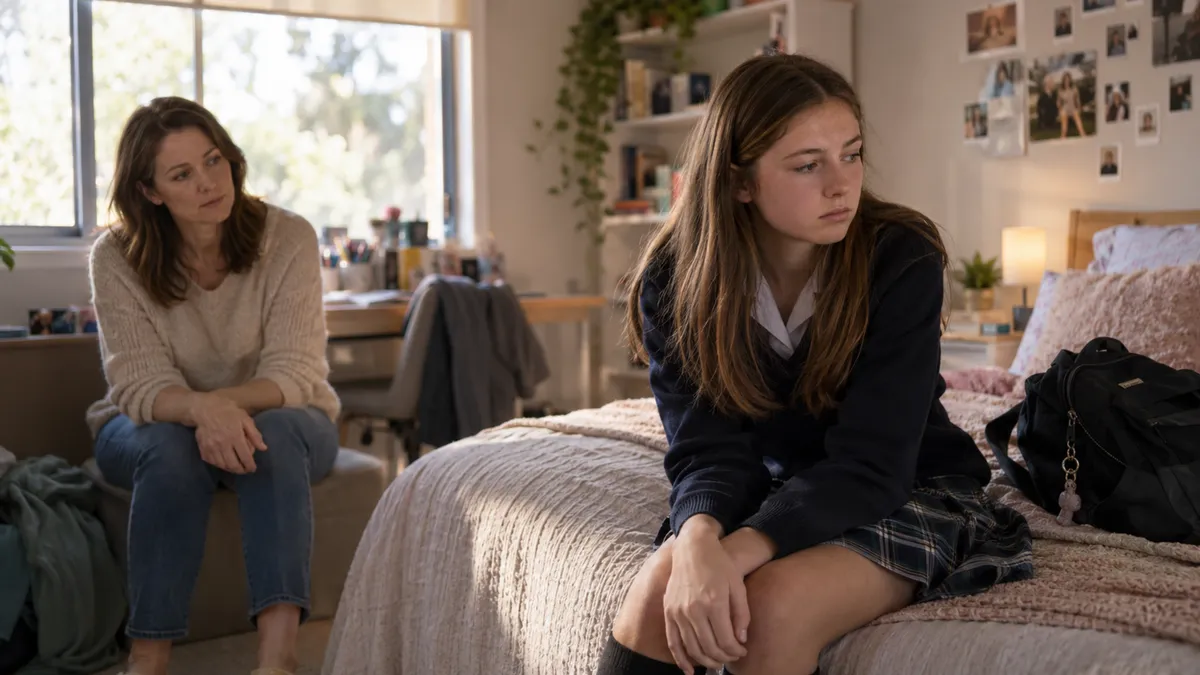
She’s thirteen, and in her first year of secondary school.
Mia was a happy, easy child in primary school, and she and her mum were close.
Really close.
Mia would openly talk about anything that was bothering her, and the two of them would sit and talk it through.
Her mum, who loves her fiercely, was always there with advice, with comfort, with a solution.
Whenever something felt hard, her mum would help her sort it out.
Her mum was her go-to person, the one who could make any problem better.
Mia grew up wrapped in that care, with almost no experience of sitting in an intense emotion long enough to let it move through her on her own.
Then secondary school arrived, and everything changed.
The social world grew complicated.
Friendships shifted in ways they never had before.
Things became more challenging.
Mia was meeting a steady stream of new, unfamiliar, more complex situations, the kind secondary school hands every young person, each one often carrying big emotions with it: disappointment, embarrassment, uncertainty, the ordinary discomfort of being thirteen.
For the first time, she was in a world her mum could not step into and fix for her.
6 months in she started pulling away.
Withdrawing.
Resisting school.
Some mornings she did not make it out the door at all.
Everyone saw a girl who was suddenly struggling with school.
What was really happening was something else entirely.
It Was Never About School
Here is what was really going on.
Mia was not struggling with school.
She was struggling with the emotions that secondary school was now asking her to navigate through, on her own, for the first time in her life.
Every child needs to slowly build the capacity to feel an intense emotion and come through it.
To be disappointed and recover.
To feel embarrassed and still move forward.
To sit in uncertainty without someone rushing to remove it.
This capacity is built the same way any capacity is built, through experience, by being allowed to feel emotions with support, so the nervous system learns, again and again, that an emotion can be fully felt and we are still okay.
Here is something most of us were never taught.
An emotion and a feeling are not the same thing.
Sadness, fear and anger are emotions, and on their own they rise, move through the body, and pass.
A feeling is the state we create when we give an emotion a meaning.
Most of us were conditioned to believe sadness, fear and anger emotions are bad, even unsafe.
So when one arrives, we give it a meaning, I am not safe, and that meaning turns a passing emotion into a stressed feeling state, one the person has unintentionally created.
Mia had, with all that loving care, rarely been given the experience of learning this for herself.
Almost every time an emotion rose and grew intense, it had been fixed, soothed, or removed before she had to fully feel it.
So she arrived at thirteen without the one thing secondary school was asking of her.
That she could navigate her own emotional world.
So when intense emotions came, and no one was there to take them away, her system did the only thing it knew.
It moved to protect her from the emotions themselves.
Pulling away from school was never the problem.
It was protection, keeping her away from an emotional world she had no living evidence she could navigate.
💡 Takeaway #1
Your teen is not struggling with school.
She is struggling with the emotions secondary school now asks her to navigate on her own, emotions she was never given the chance to learn she can move through.
The withdrawal is not the problem. It is a protective pattern, keeping her away from an emotional world she has no living evidence she can navigate.
How Protecting Her Left Her Unprotected
This is the hardest part to see, because it looks like the opposite of what it is.
Rescuing a child from every intense emotion feels like love, and it is love.
It also quietly sends a message the child’s system absorbs completely.
This feeling is too big for you.
This is not for you to hold on your own.
I can rescue you from this.
A child cared for this way does not learn that intense emotions are survivable.
She learns that those emotions are scary and unsafe, and that she is not equipped to feel them.
The protection, offered with the best intentions, quietly removes the very opportunity she needed to build her own resilience.
So the capacity never develops.
And the day the world finally hands her an emotion no one can take away, she has nothing to meet it with except the only strategy she knows.
Avoidance.
Withdrawal.
Protection.
This is not a criticism of any loving parent.
Rescuing is one of the most natural, loving instincts there is.
It is simply that constant rescuing and genuine resilience grow in different directions, because resilience is built by knowing how to safely move through intense emotions, not by having them removed.
Where the Protection Began
Here is where the real understanding starts, and it begins with gentle curiosity, turned as much toward the parent as the child.
Mia’s mum protected her so fiercely for a reason.
Perhaps she grew up with intense emotions that no one helped her navigate, and swore her own child would never feel that alone.
Perhaps she carries her own fear that certain emotions are unsafe, and soothing Mia was soothing something in herself too.
Perhaps a frightening experience taught her that a child in distress is an emergency to fix immediately.
Whatever its origin, the over-protecting was her own adaptive survival pattern, formed long ago, running automatically in her parenting.
It was never a failure.
It was love, shaped by her own history.
This invitation is gentle, and it is not about blame.
You may never pinpoint the exact moment.
What matters is the shift in understanding, seeing the protection, in both mother and daughter, as a pattern created for a reason that made sense once, and recognising that it is no longer needed now.
The Story She Had Started to Believe
There was one more layer holding Mia in place.
As the withdrawal deepened, Mia had begun to describe herself a certain way. “I’m just an anxious person. I don’t cope well with stuff. That’s how I am.”
This is the moment a created state quietly hardens into a claimed identity.
Anxiety and avoidance stops being something her system is doing, and becomes something she believes she is.
And once a young person believes they are anxious, the belief itself becomes part of the protection.
It explains the withdrawal.
It justifies avoidance.
It makes the whole pattern feel necessary, permanent and fixed, rather than created and changeable.
Here is the truth underneath it.
Mia is not an anxious person.
Mia is a capable girl who was never or rarely given the chance to build her capacity to fully feel her emotions, and whose system created protection to fill the gap.
She created anxiety, and what she created can be uncreated. “I’m an anxious person” is not who she is. It is a story she learned, and a story that can change.
What Actually Helped
Mia’s mum stopped focusing on getting her back to school.
The pressure, the negotiating, the morning battles, none of it was ever going to reach the real issue, and all of it confirmed to Mia’s system that school was the threat.
Instead, with support, two things happened together, at the root.
Mia was gently helped to build the capacity she had missed.
Not by being thrown into intense emotions to toughen up, and not by being pushed to face her fear and cope.
Slowly, safely, she was supported to be present with an intense emotion and let it move through her, so her nervous system could gather the evidence it had never been allowed to collect.
That she can feel something intense, and come through it, and be okay.
The old fear that had been living in her body, the sense that certain emotions were unsafe, was gently and fully processed, so it was no longer running underneath her days.
And her mum did her own work alongside it, learning to stay with her own discomfort when Mia was upset, rather than rushing to rescue.
Learning that the most loving thing was no longer to remove Mia’s intense emotions.
It was to stay steady beside her while she moved through them.
As this happened, something shifted.
Mia began to see herself through a different lens.
Not as an anxious person who needs protecting from a hard world, instead as a capable teen who was simply building something she had missed.
The felt need to protect herself from her own emotions started to fall away.
And as it did, school stopped registering as a threat.
There was nothing left to withdraw from, because the emotional world it represented no longer felt like something she had to be saved from.
This is the difference.
We did not help Mia cope with school, or push through her fear.
We removed the need for the protection, by giving her the capacity she had missed and resolving the fear underneath.
When the perceived need to protect herself was gone, the capable girl who had been there all along was simply free to step back into her life.
💡 Takeaway #3
The answer was never pushing her back to school, or helping her cope with the fear.
It was building the capacity she had missed, and removing the felt need to protect herself from her own emotions.
When the need to protect falls away at the root, the resistance goes with it. Your teen does not need to be made to face the world.
She needs to feel safe enough that the world stops registering as a threat.
💡 What You Can Practise This Fortnight
Look past the school. When your teen resists or withdraws, get curious about the emotions underneath, not the place or situation they are avoiding. The resistance is rarely about school. It is about an emotional world she has no evidence she can navigate.
Notice the rescuing. Gently notice the moments you step in, fix, or soften an emotion before your teen has to feel it, with curiosity rather than judgement. Each one, loving as it is, quietly says the emotion was too big for her. Noticing is what lets you adjust.
Let the emotion move, with you beside it. Instead of removing an intense emotion, stay steady while your teen feels it. “This is really hard right now. I’m right here, and we can let it be here together.” Being accompanied and safely guided through an emotional experience is how capacity is built.
Settle your own response. Your urge to rescue is often your own system finding her distress unbearable. Settling your own response, so you can stay present rather than rescue, is the quiet, powerful shift that changes everything.
Retire “she’s just anxious.” Drop the label, in your own words and in front of your teen. Anxiety is a created state, not who she is. Reflect back the capable teen underneath the pattern.
🎯 Want to Go Deeper?
Tired of walking on eggshells around your child or teen?
Watch my free 90-minute online class, anytime you like, and discover the proven approach over 1,000 families have used to bring calm, connection, and confidence back into their home.
I’m Sue, an anxiety support specialist with personal and professional experience turning stress, anxiety and chaos into calm.
With care,
Sue 😊